
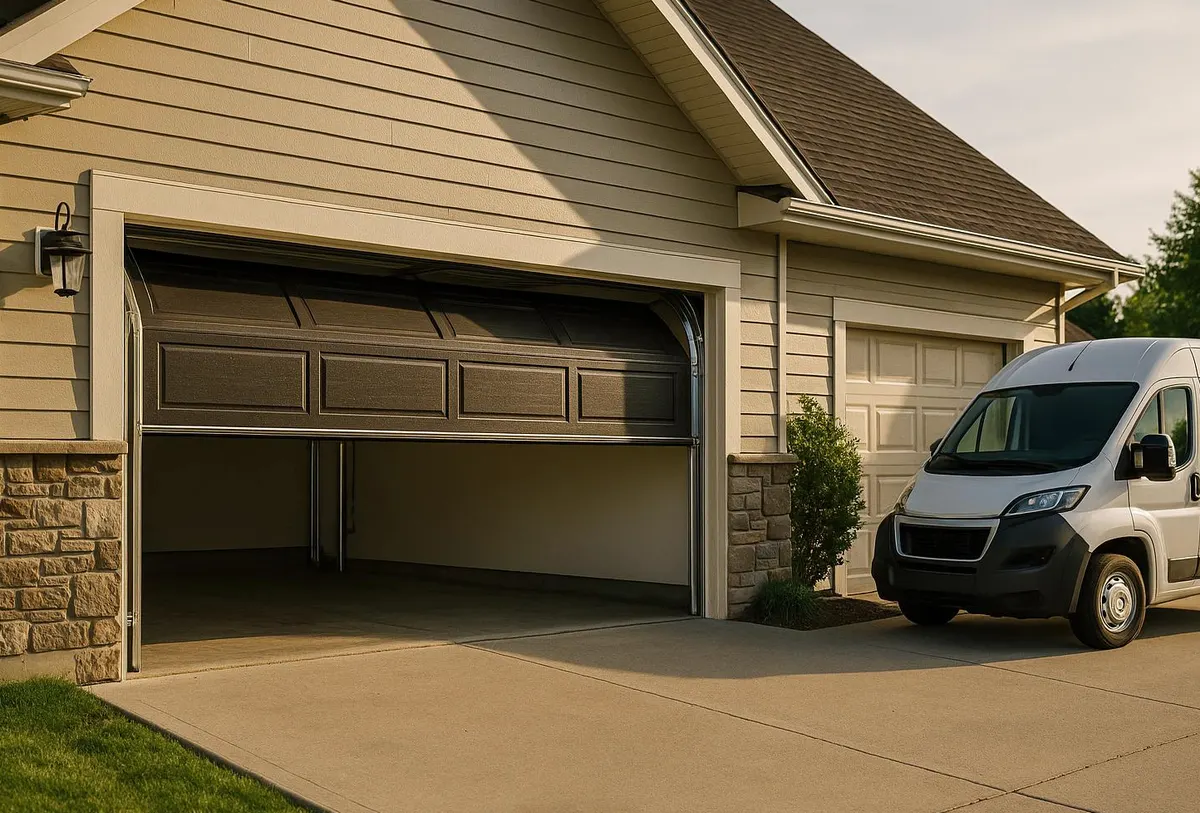
Put this off one more season and the math gets ugly fast. A garage door that buckles or blows in during a storm doesn't just mean a broken door — wind rushing into an open garage pushes up on the roof from the inside, which is how homes lose shingles, soffits, and sometimes whole roof sections in a single afternoon. Add the water that follows a breached door, and you're looking at soaked drywall, ruined storage, and a mold problem that shows up weeks later. Compare that to the cost of a spring replacement or a tune-up now, and the decision isn't close.
Why the Garage Door Is the Weakest Wall in the House
Every other exterior wall in a typical home is a solid, fastened structure. The garage door is a large moving panel held in place by springs, cables, rollers, and a track system — and it's usually the biggest single opening in the house. When wind pressure builds against a home during a storm, that door is the first thing being asked to hold the line. If the springs are tired, the track is slightly bent, or the panels are already warped from humidity, the door has almost no reserve capacity left when a gust actually tests it. Builders and engineers treat garage doors as a structural weak point for exactly this reason, which is why wind-load rated doors exist as a category — but a wind-rated door that's been neglected for years is no better than a cheap one.
What This Climate Does to a Garage Door Year-Round
Central Florida doesn't give garage door hardware an easy life. Heat and humidity swell wood-composite panels and wooden frames, which can throw a door slightly out of square without you noticing until it starts dragging or sticking partway through its cycle. Afternoon downpours drive moisture into tracks and hinges, and that moisture sits there in the humidity instead of drying out quickly, which accelerates rust on springs, cables, and hardware. If your home is close enough to catch any salt-laden air, that rust process moves even faster, pitting metal parts that look fine on the surface but are weaker than they appear. None of this causes a dramatic failure on a calm day — it just quietly removes the safety margin you're counting on when a storm actually arrives.
Signs Your Door Won't Hold Up Under Pressure
Most storm-related door failures don't happen out of nowhere. There are usually warning signs for weeks or months beforehand:
- Visible rust on springs, cables, or track brackets, especially pitting or flaking rather than light surface discoloration.
- A door that's slow, jerky, or noisy partway through opening or closing — often a sign of an unbalanced spring or a track that's shifted.
- Gaps along the sides or top where you can see daylight, which means wind-driven rain has a direct path in and the door isn't sealing against pressure the way it should.
- Panels that look slightly bowed or wavy, a common result of repeated swelling and drying.
- Cables that look frayed or have visible strands separating near the bottom bracket — these are under constant tension and are not something to wait on.
- A track that's bent or pulling away from the wall, even slightly, which reduces the door's ability to stay aligned under lateral wind force.
If You See Any of These
Don't wait for the next named storm to show up in the forecast. Hardware issues like these get worse with every cycle of the door, and springs and cables under tension can fail suddenly and dangerously if left alone.
A Practical Storm-Prep Checklist
- Tighten all hardware. Track brackets, hinges, and roller brackets loosen gradually from daily use and vibration. A seasonal pass with a wrench catches most of this.
- Check spring balance. Disconnect the opener and lift the door halfway by hand — it should stay roughly in place. If it drops or shoots up, the springs are out of balance and are not giving the door full support.
- Inspect and lubricate rollers, hinges, and tracks. This reduces strain on the opener and keeps the door moving smoothly instead of fighting its own hardware.
- Replace worn weatherstripping along the bottom and sides to cut down on wind-driven water intrusion.
- Confirm the opener has a working battery backup if you have one, since storm power outages are common here and you may need to close or secure the door manually or electrically after losing utility power.
- Consider horizontal or vertical bracing for older doors that weren't built with high wind pressure in mind, which adds rigidity without replacing the whole door.
Repair, Reinforce, or Replace?
A tune-up and hardware repair make sense when the door's structure and panels are sound and the issues are mechanical — springs, cables, rollers, alignment. If the door itself is older, visibly warped, or wasn't rated for wind pressure to begin with, reinforcement kits help but have limits, and a full replacement with a wind-rated door is the more durable fix. National replacement costs for a two-car garage door generally run from a few hundred dollars for basic hardware work up into the thousands for a full wind-rated door and opener system — the right call depends on the age and condition of what's already on the house.
When to Call Maitland Door & Opener
If your door is slow, noisy, off-balance, or showing rust on the springs or cables, that's the window to call before storm season forces the issue. We handle Garage Door Tune-Up & Maintenance to catch wear before it becomes a failure, and Garage Door Spring Repair and Garage Door Cable Repair for hardware that's already past the point of a simple adjustment. If the door is off its track or the panels are compromised, we'll walk you through whether a repair holds up or whether it's time to talk replacement.
If you're in Maitland, Winter Park, Orlando, Altamonte Springs, Casselberry, Longwood, Eatonville, or Fern Park and you want your garage door actually ready for this season's storms instead of hoping it holds, call Maitland Door & Opener and we'll get it checked out.